
Thank you for Subscribing to Chemical Industry Review Weekly Brief



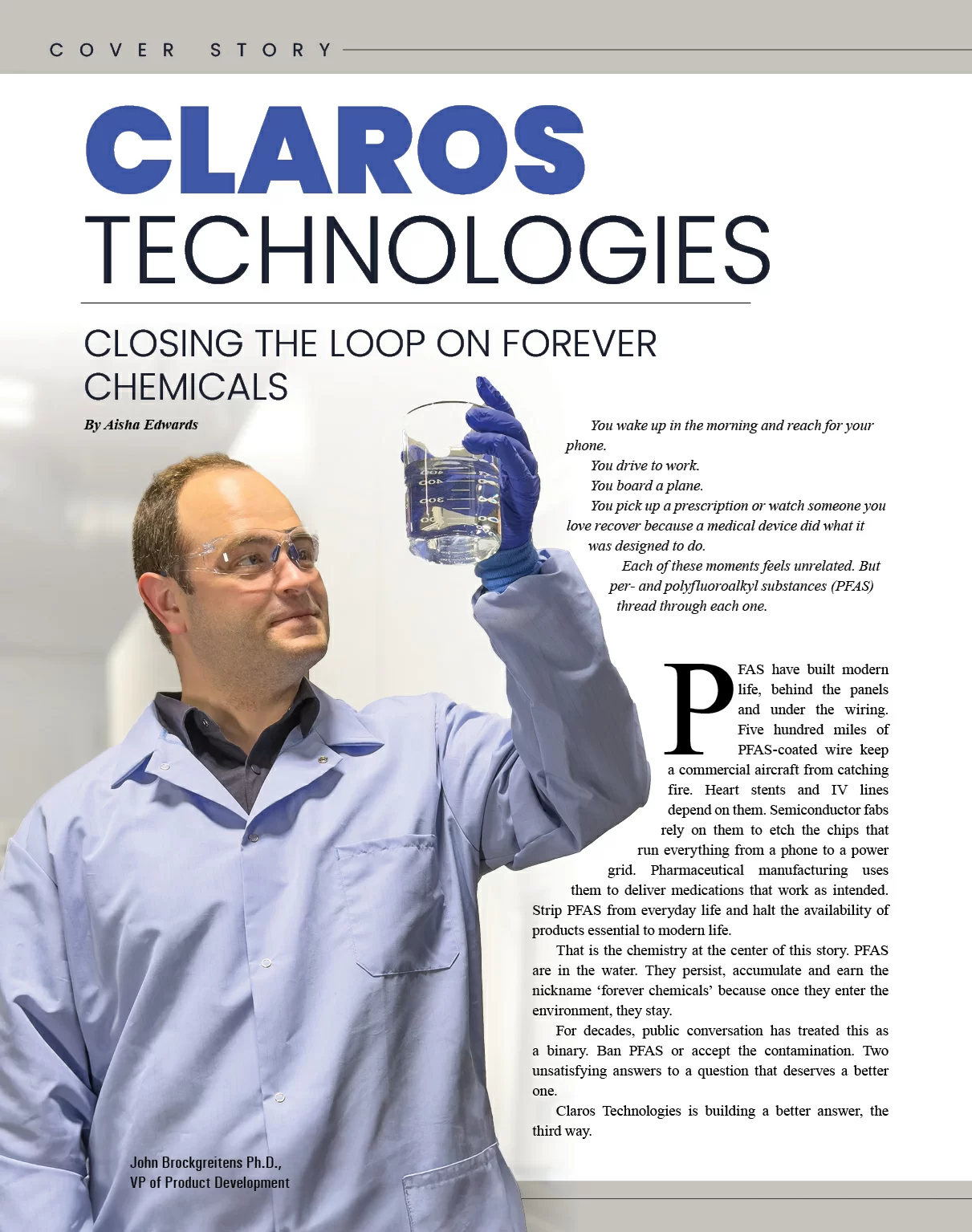
 John Brockgreitens Ph.D., VP of Product Development
You wake up in the morning and reach for your phone. You drive to work. You board a plane. You pick up a prescription or watch someone you love recover because a medical device did what it was designed to do.
Each of these moments feels unrelated. But per- and polyfluoroalkyl substances (PFAS) thread through each one.
PFAS have built modern life, behind the panels and under the wiring. Five hundred miles of PFAS-coated wire keep a commercial aircraft from catching fire. Heart stents and IV lines depend on them. Semiconductor fabs rely on them to etch the chips that run everything from a phone to a power grid. Pharmaceutical manufacturing uses them to deliver medications that work as intended. Strip PFAS from everyday life and halt the availability of products essential to modern life.
That is the chemistry at the center of this story. PFAS are in the water. They persist, accumulate and earn the nickname ‘forever chemicals’ because once they enter the environment, they stay.
For decades, public conversation has treated this as a binary. Ban PFAS or accept the contamination. Two unsatisfying answers to a question that deserves a better one.
 Claros Technologies is building a better answer, the third way.
ClarosTechUV™ destroys long-, short- and ultra-short-chain PFAS compounds in aqueous waste streams at rates of hundreds of gallons per minute, with 99.99 percent effectiveness using a proprietary reactor system. What this means is that PFAS chemistries are broken apart and mineralized down to their elemental components, primarily fluoride ions, rather than captured and moved elsewhere. Permanent destruction is now possible.
“The story is not simply about a new technology. It is about an inflection point where the PFAS challenge begins to shift from a problem that must be managed to one that can realistically be solved,” says John Brockgreitens, Ph.D., VP of Product Development and Co-founder of Claros Technologies.
There are places where, as much as regulation is ramping up, industries still need to use these materials, but stop them from leaving the waste stream. For those situations, we have a solution that helps them stay ahead of regulation.
Industries that depend on PFAS no longer have to choose between using them and protecting the environment around their facilities. Regulators no longer have to weigh economic disruption against environmental responsibility.
What Capture Could Never Solve
Why are traditional PFAS capture and disposal methods insufficient for long-term remediation?
Conventional PFAS treatment uses activated carbon filters, reverse osmosis and ion-exchange resins to capture PFAS contaminants. Reverse osmosis systems pull PFAS compounds from a water stream, concentrate them elsewhere and generate reject brine. Activated carbon systems produce spent media. Ion-exchange systems exhaust their resins. Each approach leaves something behind.
Then comes the awkward question. ‘What do you do with what is left behind?’
Operators have three options, none of them good. Incineration burns waste, imposing its own costs and emissions burden. Landfill disposal pushes contamination underground, where it leaches over time. Trucking the waste elsewhere hands the problem to another facility. Each route ends with the same compounds existing somewhere, waiting.
 “There are very few solutions right now in the marketplace that will destroy all PFAS species (long, short and ultra-short) at a very high flow level and that is where we uniquely fit. We can take a customer’s water stream, analyze it, determine which PFAS compounds are present and with our proprietary UV system, process the water and destroy the PFAS,” says Brockgreitens.
ClarosTechUV inverts the treatment logic. PFAS gets destroyed earlier in the process, before it accumulates in filtration media. Volumes of contaminated waste shrink, disposal costs drop and liability is resolved at source.
System placement adapts to each application. Claros analyzes the waste stream first, then positions the system at the point in the treatment train where destruction performance peaks and operating cost bottoms out.
Why UV Was Counted Out
How does Claros Technologies use advanced UV reactor engineering to destroy PFAS compounds at scale?
UV technology has been a workhorse in water treatment for decades, primarily in disinfection. When early researchers attempted to apply conventional UV processes to PFAS destruction, the results were disappointing. Industry concluded UV was not up to the job. Capital flowed toward alternatives such as supercritical water oxidation, hydrothermal alkaline treatment and plasma systems. Each works, but demands high capital, significant energy and complex operations.
 Claros looked at the same data and reached a different conclusion. Early failures reflected the limits of early designs; UV itself was never the ceiling. Reactor architecture rebuilt from first principles, paired with in-house-developed proprietary chemistry, enabled ClarosTechUV to achieve industrial-scale defluorination that earlier UV systems could not.
The carbon-fluorine bond is the strongest single bond in organic chemistry and it is the reason PFAS persist in the environment. Breaking it at scale is the engineering achievement at the heart of the platform.
“ClarosTechUV may share the UV label with earlier UV systems, but the underlying engineering is fundamentally novel and different,” says Brockgreitens.
The Lab Behind the Reactor
Why are PFAS analytics, regulatory compliance and scalable destruction infrastructure becoming critical for industry?
ClarosLabs™ is the analytical division driving Claros’s work. Since its founding in 2020, the lab has processed over 40,000 samples using targeted testing, non-targeted analysis and molecular fingerprinting techniques, including high-resolution mass spectrometry. The work identifies which PFAS compounds are present in a given waste stream and how they behave under treatment conditions.
-
The story is not simply about a new technology. It is about an inflection point where the PFAS challenge begins to shift from a problem that must be managed to one that can realistically be solved
PFAS is a class of more than 10,000 compounds. Each behaves differently and requires different conditions to break apart. Without rigorous analytical capability, destruction technology runs blind.
“We became PFAS detection experts so we could become PFAS destruction experts,” says Brockgreitens.
Legal counsel working with and advising Industrial customers facing legal scrutiny may be able to retain Claros to perform Attorney-Client Privileged Analytical Assessments.
The Regulation Tide
Regulatory pressure on PFAS is rising worldwide. State-level action in the U.S. is moving faster than federal rulemaking, while Europe’s Registration, Evaluation, Authorization and Restriction of Chemicals (REACH) framework is pushing toward broad restrictions. Direction is unmistakable. Limits are getting stricter, more compounds are being brought under coverage and compliance windows are shrinking.
Industries most exposed cannot simply walk away from PFAS. Semiconductors, pharmaceuticals, specialty chemicals, advanced textiles and packaging rely on PFAS for performance properties that no current substitute can match.
What they need is a way to keep using them without releasing them.
“For many industrial users, the issue is no longer whether PFAS regulation is coming, but how to manage emissions responsibly while those chemistries remain in use,” says Brockgreitens.
Older treatment technologies were built around long-chain compounds, the legacy molecules that drew the first wave of regulatory focus. Smaller variants slip through capture systems and increasingly draw their own restrictions. Any technology that cannot address them is on a clock. ClarosTechUV destroys all three categories, including ultra-short-chain compounds, which remain the hardest to break apart.
Capital invested in treatment infrastructure today has to survive the next regulatory tightening. Spending millions on a system that handles only currently regulated compounds creates stranded assets the moment the rulebook expands. Operators want infrastructure that holds up across multiple compliance cycles. Claros gives them that runway and lowers their ongoing exposure.
Proof in the Field
How is Claros Technologies scaling PFAS destruction for industrial, municipal and environmental applications?
Field results validate the platform. Claros works with Daikin America on industrial-scale PFAS destruction. A recent pilot proved ≥99.99 percent PFAS destruction in groundwater from a 3M-related remediation site, anchoring the underlying science. Customers across pharmaceutical, semiconductor and other industrial sectors are running ClarosTechUV.
Municipalities and environmental agencies are part of the conversation as well.
“Drinking water standards are tightening and remediation budgets are expanding. The same destruction platform serves public and private operators alike,” says Brockgreitens.
Claros delivers regulatory compliance, reduces operating costs and engineers treatment infrastructure to absorb the next regulatory shift without another round of capital spending.
Leadership reinforces the platform’s credibility. Co-founder and CEO Michelle Bellanca spent years as a senior executive at 3M. Her team brings deep operational backgrounds in industries that manufacture or depend on PFAS. That collective experience informs how Claros approaches risk, regulation and adoption inside complex industrial organizations.
The Scale of What Comes Next
PFAS remediation represents a market of hundreds of billions of dollars worldwide, spanning industrial wastewater, municipal systems and drinking water infrastructure. Industrial wastewater is where ClarosTechUV operates today. Groundwater, municipal water and drinking water may be the next steps.
Modularity is the near-term engineering focus. Greater modularity means broader commercial deployment, faster integration into diverse facility configurations and lower implementation friction for new customers.
That combination of commercial validation, scientific depth and regulatory engagement earned Claros Technologies recognition as Sustainable PFAS Destruction Solutions of the Year by Chemical Industry Review.
The Promise
The PFAS conversation has carried a particular weight for years. A sense that the modern world built itself on a chemistry it could not undo. A feeling that environmental responsibility and industrial progress would have to fight it out, with one of them losing.
Claros Technologies is dismantling that premise.
“Our technology allows both sides to move beyond the idea that addressing PFAS requires choosing between environmental protection and economic progress,” says Brockgreitens.
Phones still get made, planes still fly, Fabs still etch semiconductors. Industries that need PFAS keep using them. The water leaving the facility is clean.
Forever chemicals are no longer forever. That sentence was, until recently, wishful thinking. It is becoming engineering.
Permanent Solutions for PFAS in Industrial Water Systems
Per- and polyfluoroalkyl substances have become embedded in modern industrial systems, supporting applications across medical devices, electronics, aviation and pharmaceuticals. Their persistence, once considered an advantage, now presents a regulatory and environmental dilemma that is intensifying across jurisdictions. Industrial operators face a narrowing margin for error as compliance thresholds expand from a handful of legacy compounds to entire chemical families. Decision-makers are no longer evaluating whether to address PFAS, but how to do so in a way that avoids repeated capital cycles and shifting liability.
Conventional treatment strategies have largely centered on capture and containment. Filtration, adsorption and separation technologies concentrate contaminants without eliminating them, transferring risk from water streams into solid waste or secondary processes. Disposal pathways, such as incineration or landfill, introduce additional uncertainty, particularly as scrutiny of long-term environmental releases increases. Short-chain and ultra-short-chain compounds complicate this approach, as they often evade traditional capture methods and persist in treated outputs. The result is a fragmented system that manages exposure without resolving the underlying chemical presence.
A more durable approach is emerging through technologies capable of breaking down PFAS compounds directly within aqueous environments. Permanent destruction shifts the conversation from mitigation to elimination, reducing dependence on downstream handling and minimizing the risk of re-entry into the environment. This shift is closely tied to cost predictability, since systems that address a broader spectrum of compounds reduce the likelihood of retrofits as regulations evolve. Treatment strategies that can be integrated earlier in the water processing sequence also improve overall efficiency by preventing accumulation in filtration media and lowering disposal volumes.
Clarity in measurement has become equally important. PFAS represents a diverse class of chemicals with varying behaviors, making incomplete detection a barrier to effective treatment design. Advanced analytical approaches that combine targeted and non-targeted methods provide a more accurate understanding of contamination profiles, enabling operators to align treatment processes with actual chemical conditions rather than assumed ones. Data transparency plays a critical role in regulatory engagement, where validation of destruction performance is increasingly required to demonstrate compliance and long-term safety.
Another layer of complexity arises from the pace of regulatory change. Operators must make capital decisions today that remain viable under future standards, even as agencies expand compound lists and tighten discharge limits. Solutions that only address currently regulated substances risk becoming obsolete as oversight broadens. A forward-looking approach favors systems capable of treating both known and emerging PFAS compounds, thereby reducing reinvestment costs and ensuring continuity in compliance strategies. This expectation is shaping procurement decisions across sectors that depend on PFAS-enabled materials.
Within this evolving landscape, Claros Technologies represents a compelling option for industrial operators confronting PFAS contamination. Its ClarosTechUV system applies a proprietary UV photochemical process designed to permanently destroy long-chain, short-chain and ultra-short-chain PFAS compounds in industrial aqueous waste streams at commercial scale, addressing a persistent gap left by capture-focused methods. The system’s ability to operate earlier in treatment sequences improves efficiency while reducing downstream waste burdens and contaminated media volumes. Complementing this, ClarosLabs provides targeted testing, non-targeted analysis, molecular fingerprinting and high-resolution analytical capabilities that enable precise characterization and validation of treatment outcomes. This integration of destruction and measurement supports both regulatory confidence and cost control, positioning Claros as a credible path toward permanent PFAS elimination.
...Read more
PFAS Destruction Technology Solutions Info
Q1
What Should Buyers Expect From Sustainable PFAS Destruction Solutions?
Sustainable PFAS Destruction Solutions should do more than simply remove contaminants from water. The goal is to actually break down PFAS compounds into safer elemental byproducts while reducing the amount of secondary waste created during treatment. Buyers should look closely at whether a system can handle long-chain, short-chain and ultra-short-chain PFAS compounds since future regulations may expand beyond the chemicals older systems were designed to treat. A strong solution should also provide clear evidence that PFAS is being destroyed rather than just transferred somewhere else in the treatment process.
Q2
How Does Claros Technologies Treat PFAS at an Industrial Scale?
Industrial facilities need PFAS treatment systems that can perform reliably under real operating conditions, not just in controlled lab environments. Claros Technologies uses its proprietary ClarosTechUV process, a UV-photochemical reactor system designed to treat high-throughput aqueous waste streams while targeting 99.99 percent destruction of specific PFAS compounds. Its Sustainable PFAS Destruction Solutions can also sit upstream of large filtration systems, helping reduce the amount of contaminated media that eventually requires disposal. That approach can lower operational costs while reducing the burden of managing additional waste streams later.
Q3
Why Does Testing Matter Before Destruction Begins?
PFAS is not a single chemical but a large group of compounds that behave differently depending on chain length, concentration and water chemistry. ClarosLabs supports Sustainable PFAS Destruction Solutions through targeted testing, non-targeted analysis, molecular fingerprinting and high-resolution mass spectrometry. This testing helps facilities understand exactly which PFAS compounds are present before treatment begins and ensures systems are designed around actual site conditions instead of assumptions. Without proper testing upfront, treatment systems may fail to address the compounds moving through the water stream.
Q4
How Do These Systems Reduce Disposal Burdens?
Traditional capture-based treatment methods often create another disposal challenge by leaving behind spent carbon, exhausted resin, reject brine or concentrated PFAS waste. Sustainable PFAS Destruction Solutions change that equation by targeting PFAS compounds earlier in the treatment process and breaking them down at the source. Instead of transferring contamination to another disposal site, destruction-focused systems can reduce downstream waste volumes and provide clearer proof that PFAS has actually been addressed. For many facilities, the key question is not just whether PFAS leaves the water, but where it ends up afterward.
Q5
Where Can PFAS Destruction Fit in Public and Private Water Treatment?
PFAS destruction systems can be integrated into many different treatment environments depending on flow rates, contamination levels, facility layouts and regulatory requirements. Sustainable PFAS Destruction Solutions may support industrial manufacturers, semiconductor facilities, airports, landfills, municipal water systems and PFAS producers themselves. Claros Technologies highlights applications ranging from wastewater treatment and landfill leachate to AFFF-related airport contamination, showing that treatment strategies often need to be customized for each site. Public agencies may prioritize discharge compliance, while industrial operators may focus more heavily on proving destruction within existing infrastructure.
Q6
What Should Decision-Makers Review Before Investing?
Before investing in a PFAS treatment system, decision-makers should evaluate the technology against actual site conditions rather than relying only on general presentations or lab data. Important factors include compound coverage, flow capacity, energy demand, third-party validation, analytical reporting and regulatory documentation. Strong Sustainable PFAS Destruction Solutions connect treatment chemistry, testing and compliance evidence throughout the entire process, from sample analysis through final performance validation. Pilot testing is also important because PFAS concentrations and water chemistry can vary significantly under real operating conditions.
