
Thank you for Subscribing to Chemical Industry Review Weekly Brief



 Rosario Licciardello, CEO and Owner
Locally known as the “godfather of silanes”, Licciardello founded ROYALSIL Inc. in 2010, bringing his technical expertise to solve formulation challenges, source hard-to-find, exotic silanes and obtain materials in the quantities customers need, with prompt, reliable delivery.
“I understand what the silicon chemistry will do for the end user. This allows me to have a very high-level conversation with the customer,” says Licciardello, CEO and owner.
He also serves as the de facto technical director, acting as the primary point of contact for technical assistance, commercial guidance and chemical expertise.
The specialty chemical distributor initially supplied a wide range of silicon-derived products before narrowing its focus to silanes. Today, ROYALSIL directly serves customers and resellers in markets including paints, adhesives, caulks, sealants, coatings, wire and cable, mineral fillers, flooring, rubber, plastics and oilfield applications. It maintains a U.S.-based inventory of approximately 20 conventional silanes and provides access to over 100 commercial and specialty silanes on a spot basis for customers seeking highly specialized formulations.
Getting the Chemistry Right
Silanes are commonly used as coupling agents that connect compatible materials. Their effectiveness depends partly on the availability of suitable hydroxyl groups on a surface. Certain plastics, including PVC, polypropylene and most olefin-based materials, can present challenges for conventional silane treatments.
Even when silane is a suitable candidate, selecting the right chemistry does not always guarantee a good result. The real challenge is determining how to use it.
I understand what the silicon chemistry will do for the end user. This allows me to have a very high-level conversation with the customer.
The same silane can produce different results depending on the substrate, concentration, order of addition and processing conditions. Temperature, pH and humidity can all influence performance. In addition, too little silane may not provide the intended effect. Too much can be counterproductive, as the material can potentially react or cross-link with itself instead of contributing effectively to the desired interface.
For customers working with formulation and manufacturing challenges, these variables can make the difference between an improvement and a disappointing trial.
To ensure that silane produces desired results, Licciardello encourages a measured approach to application testing. Customers can test a concentration ladder, starting with 0.25 percent with increments of 0.25 percent, eventually reaching one percent and progressively higher levels, where appropriate. The results can be assessed through destructive or non-destructive testing that identifies the concentration that meets the application's requirements.
“Chemical selection in the case of silanes must be supported by evidence, and not based on the assumption that adding a material will automatically improve performance,” says Licciardello.
Technical Expertise That Solves Customer Problems
A customer may approach ROYALSIL convinced that a silane will improve adhesion or enhance the interaction between two materials. Licciardello starts by assessing the customer’s needs.
He answers technical and commercial questions directly, avoiding the delays associated with information passing through multiple teams or time zones. He examines the application, the substrates, the performance problem to be addressed and if the material has the surface chemistry for silane to work.
“Silanes have their strengths, but they aren’t the answer to every challenge,” says Licciardello.
When the chemistry is unlikely to work, Licciardello explains why at the outset rather than encouraging a purchase that may waste material, testing time and development costs. The objective is to help the customer make a better-informed decision.
Access to Silanes Others May Not Supply
ROYALSIL applies the same customer-first philosophy to sourcing. Its model is designed to obtain silanes that meet a customer’s specifications, including specialized materials that are difficult to source.
-
Chemical selection, in the case of silanes, must be supported by evidence, and not based on the assumption that adding a material will automatically improve performance.
Not every customer needs a commodity silane in large volumes. Some need a familiar product for ongoing production. Others need a specific, less common chemistry to test an idea or investigate a performance problem.
In some cases, a material identified in a patent or technical paper may be exactly what a development team needs, but difficult to source in the required quantity. Exotic or boutique silanes, for instance, may be needed by some customers in small quantities for initial research and testing, with demand potentially growing as a formulation moves toward commercial use. Larger suppliers may be less inclined to handle a small, specialized order, particularly when the material is expensive or demand is limited.
ROYALSIL’s sourcing model accommodates these needs. It includes access to boutique and exotic silanes that can be ordered in small quantities. The portfolio has evolved in response to customer requests.
For businesses managing production schedules or time-sensitive development trials, availability can be as consequential as the product's technical properties. ROYALSIL's policy is to maintain approximately six to nine months of inventory. This enabled it to continue supplying customers during the severe material shortages of 2022. The high level of service is also delivered with competitive pricing, as all commercial decisions are handled directly by Licciardello.
Flexible, Timely Supply With Strict Quality Control
ROYALSIL combines its select inventory with flexible packaging and fulfillment. Depending on the product and order, customers can receive materials in bulk containers or totes, drums, five-gallon pails or one-gallon pails.
For many pail orders, repackaging and fulfillment are completed within 24 to 48 hours. Keeping stock and repackaging capabilities in the U.S. also helps customers avoid the delays and costs associated with overseas shipments, and reduces the risk of damage during transport.
 ROYALSIL maintains a direct route between the supplier and the customer, with relatively few intermediaries. This arrangement supports ease of communication when an order requires technical clarification or a particular package size.
Responsiveness is not limited to business hours. ROYALSIL makes itself available around the clock to customers, resellers and suppliers, including those operating across international time zones. It responds to requests and provides order acknowledgments within 24 hours.
This responsiveness is grounded in lessons from Licciardello's long career in specialty chemicals. He saw how slow response times and organizational complexity could affect a customer's experience. He wanted to build a business where customers could promptly obtain answers and order acknowledgments.
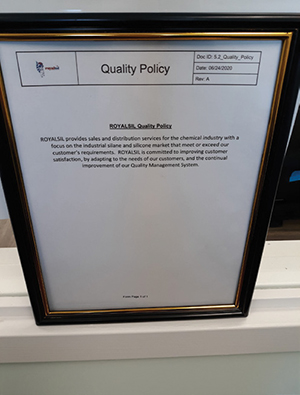 For specialty chemicals, reliable and timely supply must be matched by equally careful attention to specifications. ROYALSIL specifies requirements for characteristics such as refractive index, specific gravity, color and purity to its suppliers. Purchase orders to suppliers make clear that materials failing to meet the specified requirements are subject to return. A gas chromatography (GC) chart is included in the certificate of analysis, giving customers an additional reference for evaluating purity.
Careful handling supports that quality discipline. Exposure to moisture can hydrolyze sensitive silanes, affecting their purity and performance. To protect the integrity of silane during sampling or repackaging, opened drums are purged with dry nitrogen before resealing them.
Preparing for the Next Chapter
In its next stage, ROYALSIL anticipates a merger or the sale of a partial interest in the business. Licciardello’s broader aim is to find a structure that supports the company’s continued development while preserving the technical expertise and service approach that define its customer relationships.
ROYALSIL's recognition as Silanes and Specialty Chemical Supply Service of the Year 2026 highlights its expertise in the specialty chemicals industry.
What Silane Buyers Should Verify Before Ordering
Buying specialty chemicals involves more than finding a supplier with the right CAS number and a competitive price. Silanes can behave differently depending on the substrate, moisture exposure and how they are added to a formulation. Even small changes in concentration can affect the result. A supplier may deliver quickly, but without the right technical advice, customers can end up spending time and money on failed trials or reformulation. Technical knowledge matters as much as reliable supply.
The first question is whether the silane is suitable for the intended substrate. As coupling agents, silanes need compatible surface chemistry to form an effective bond. A supplier should understand the polymer or substrate involved and be able to identify applications where silane chemistry is unlikely to help. Establishing this before sampling can save customers from testing a material that has little chance of improving adhesion.
Choosing the right silane is only part of the process. Concentration, temperature, pH and the order in which ingredients are added can all affect performance. Using too much silane may even reduce effectiveness because of self-crosslinking. Moisture is another concern, as silanes react readily with water. Proper storage and dry-gas purging help protect material quality after a container has been opened. Useful technical support should cover these practical details rather than stop at recommending a product.
Availability is equally important, particularly for customers who use silanes regularly. Domestic inventory can shorten delivery times and reduce dependence on overseas shipments. But stock alone is not enough. Suppliers need to check incoming materials against specifications for purity, refractive index, color and specific gravity. Buyers should understand how off-specification material is handled and whether certificates of analysis are backed by analytical records that verify purity.
“ROYALSIL helps customers assess substrate compatibility and understand how concentration, temperature, pH and handling conditions affect silane performance.”
Inventory levels can make a difference when supply chains are disrupted. A supplier holding several months of stock may be able to keep customers supplied during temporary shortages. This gives manufacturers more time to plan qualification work, manage changes in demand and avoid making last-minute substitutions when overseas shipments are delayed.
Packaging is another practical consideration. Manufacturers with steady, high-volume demand may prefer drums or intermediate bulk containers, while smaller pails can be more suitable for trials or limited production. The aim is to buy quantities that match actual use without creating unnecessary waste or delays.
ROYALSIL Inc. stocks about 20 silanes in the United States and can source more than 100 additional specialty silanes on a spot basis. This gives customers ready access to commonly used products while allowing them to obtain less widely available chemistries when needed.
ROYALSIL helps customers assess substrate compatibility and understand how concentration, temperature, pH and handling conditions affect silane performance. Its technical guidance helps customers identify suitable materials and avoid problems during formulation and use.
The company maintains six to nine months of inventory and ships many orders within one or two days. It also repurges opened drums with dry nitrogen before repackaging or sampling to help protect material quality.
For manufacturers that need dependable silane supplies and practical application advice, ROYALSIL combines domestic inventory, access to specialty chemistries and technical support. Its approach is particularly relevant when material selection, handling conditions and delivery reliability can affect production.
...Read more
